
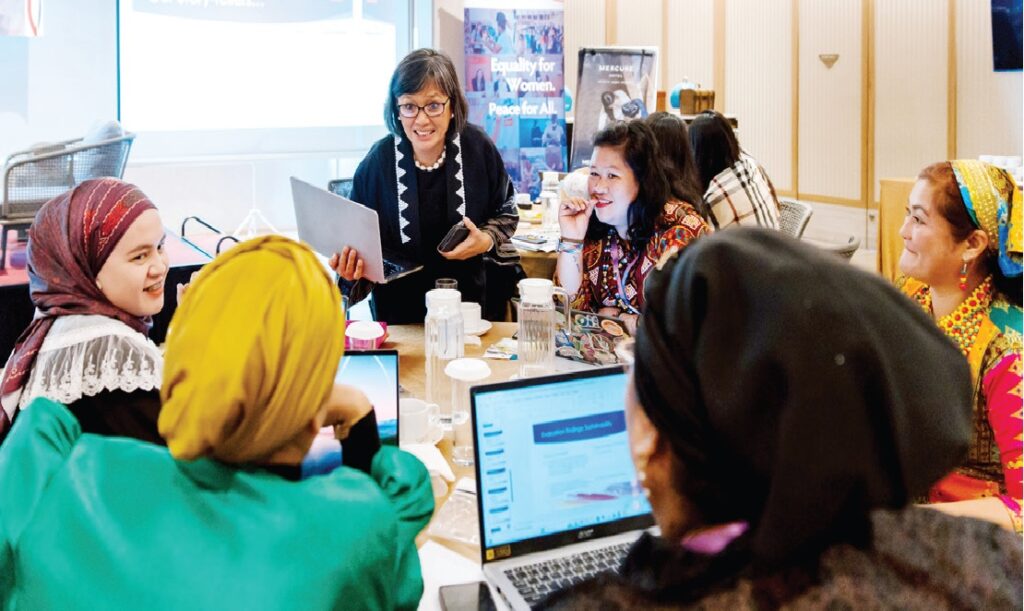
Ms. Minette Soriano guides the Philippine team sharpens their focus on key findings and streamlines their presentation for maximum clarity and impact.
Women leaders in Lanao del Sur and across the Bangsamoro Autonomous Region in Muslim Mindanao (BARMM) may find themselves taking on more challenging roles in policy and peacebuilding agenda if they got the necessary tools and skills.
This was the gist of the sessions for women leaders engaged in conflict, displacement, and climate risks in critical areas as the ASEAN Regional Plan of Action on Women, Peace, and Security (ASEAN RPA on WPS) offered a framework to address these gaps. Ms. Aquila M. Kahar of MARADECA, who represented civil society sector of Lanao del Sur said the series of Monitoring, Evaluation, and Learning (MEL) trainings held in Manila, Bangkok, and Jakarta, highlighted Important points such as creating indicators that reflect women’s lived experiences, applying community-led data collection methods, and ensuring findings directly influence policy changes.
During the final workshop in Jakarta on February 24–26 Ms. Kahar said the participants engaged in designing and refining MEL tools for conflict-affected communities. “Data is not just numbers—it’s a story of people’s lives, and if we fail to capture the voices of women, we fail to tell the full story of peace,” said Ms. Minette Soriano, a resource persons in the MEL training. She said the MEL “is more than a technical tool; it is a means to amplify the voices of women in conflict-affected areas”. Ms. Kahar also presented MARADECA’s evaluation plan, presented during the workshop, addressed the specific challenges and opportunities of integrating women’s perspectives into peace and security policies in Lanao del Sur. The ASEAN RPA on WPS was attended by delegates from
the Philippines, Thailand, Indonesia, Cambodia, and Vietnam.