
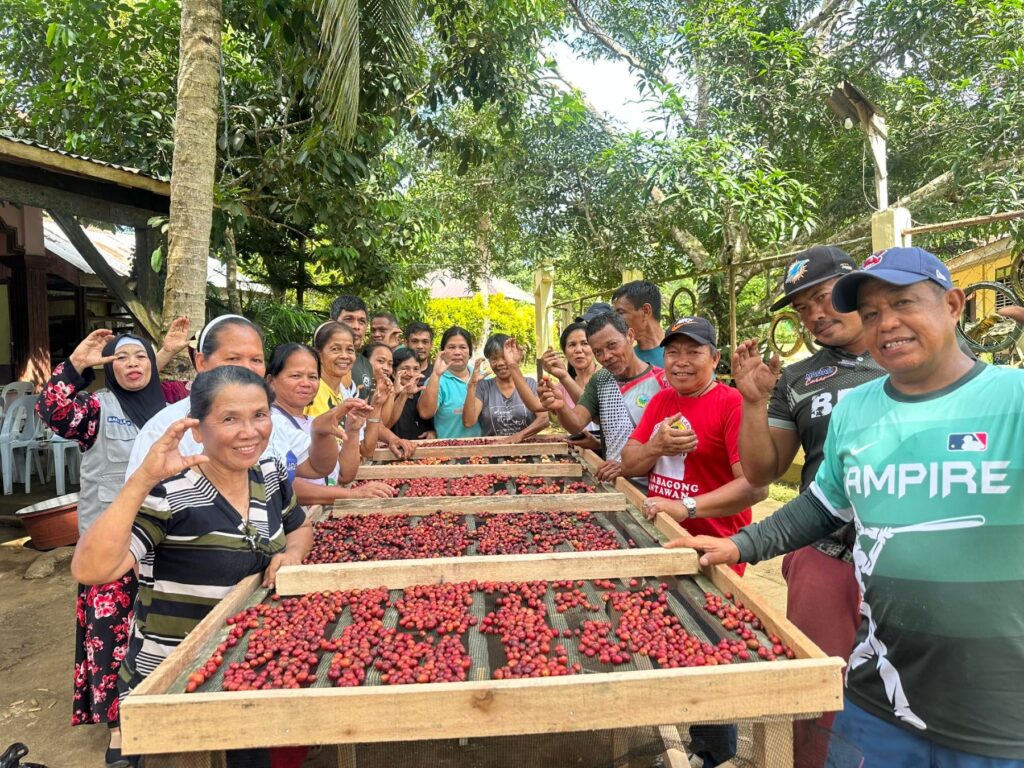
 Proper post-harvest handling is critical for coffee quality and market value, yet it remains challenging for smallholder farmers in Bangsamoro. To address this gap, the Coffee Post-Harvest Handling and Processing training under LEAP project reached 808 participants across Basilan and Sulu: 66 participants from Barangay Buheyawas, Lamitan City, and Barangay Tairan, Lantawan in Basilan, and 742 participants from 10 barangays across Patikul, Indanan, and Talipao in Sulu.
Training emphasized that drying dictates the final quality, flavor, safety, and market value of coffee beans, making it one of the most critical post-harvest steps. However, many coffee farmers traditionally dry their beans on roads, where the beans absorb foul odors from asphalt, vehicle fumes, and road heat. This practice ruins the coffee’s natural aroma and flavor, leading to lower market value and rejection by quality buyers.
Farmers learned selective manual harvesting, focusing on picking only ripe cherries, along with proper floating, sorting, and drying techniques using elevated platforms rather than roads or bare ground.
In Barangay Kabbon Takas, Patikul, the training’s impact extended beyond individual practice when the Barangay Captain issued an ordinance prohibiting road drying, leading to increased adoption of solar dryers. The barangay ordinance was enacted to ensure the safety and Halal compliance of coffee beans by maintaining cleanliness and preventing contamination from animal waste (which would render them Haram) and pollution such as vehicle emissions. Farmers received nets and tarpaulins for constructing improved drying facilities.
“Before, we placed coffee cherries directly into sacks without proper drying or sorting, and the beans often turned black. Today, we understand that quality coffee requires careful handling at every step.”-Reynaldo A. Parado, Cluster Leader, TARBAMC, Barangay Tairan, Basilan.
These targeted interventions intend to improve product quality, increase incomes, and strengthen sustainable livelihoods across coffee-growing communities in Bangsamoro.